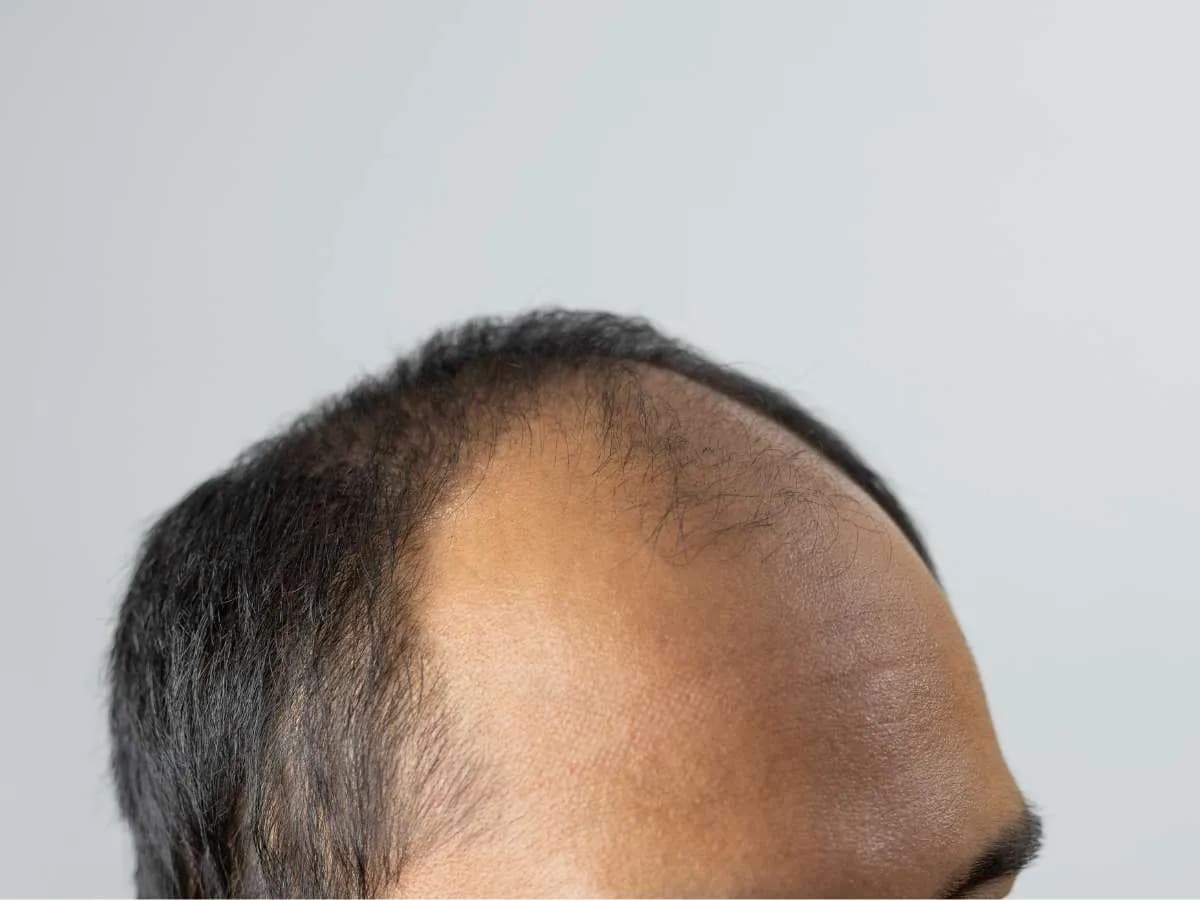
Key Signs and Early Indicators of Male Pattern Baldness
Male pattern baldness doesn't happen overnight. Men who catch the warning signs early have a better chance of slowing down hair loss before it becomes severe.
Receding Hairline and Hairline Recession
A receding hairline often appears as the first noticeable sign of male pattern baldness. The hairline gradually moves backward from the forehead, typically creating an M-shaped pattern where hair thins at the temples while remaining thicker in the middle.
This differs from a mature hairline, which is a normal slight recession that happens to most men in their late teens or early twenties. With androgenetic alopecia, the recession continues past this point and keeps moving backward.
Filipino men in their late twenties and early thirties often notice temple recession first. The hair at the temples becomes finer and weaker before disappearing completely. Some men see this change happen over months, while others notice it developing over several years.
Many men experience crown thinning before they notice hairline changes. The vertex, or top of the head, starts to show less density as hair follicles shrink due to dihydrotestosterone exposure.
A small bald spot may form at the crown that gradually expands outward. Men often don't notice this pattern because it's difficult to see without using mirrors or having someone point it out. The hair feels less dense when styling, and the scalp becomes more visible under bright lights.
DHT causes the follicles in this area to miniaturize over time. The hair becomes thinner and shorter with each growth cycle until the follicles stop producing visible hair completely.
Widening Part and Generalized Thinning Hair
Some men don't follow the typical patterns of hairline recession or crown balding. Instead, they experience diffuse thinning across the entire scalp, which makes the hair part appear wider and more noticeable.
This type of male pattern hair loss creates an overall reduction in hair density rather than concentrated bald spots. The hair looks flat and lifeless, making it harder to style. The scalp becomes more visible through the hair, especially under fluorescent lighting or in photos.
Diffuse thinning can be harder to identify early because it happens gradually across the whole head. Men may notice their ponytail feels thinner or their usual hairstyle no longer provides adequate coverage.
Increased Hair Shedding and Slower Hair Regrowth
Normal vs. Excessive Shedding:
- Normal: 50-100 hairs per day
- Concerning: 150+ hairs per day or clumps of hair
Increased shedding serves as an early warning sign that something has changed with scalp health. Men notice more hair on their pillow, in the shower drain, or on their brush. The hair that sheds may also appear thinner and shorter than normal, indicating miniaturization has begun.
Another key indicator is slower regrowth. When hair falls out naturally, it should be replaced by new growth within a few months. With androgenetic alopecia, the replacement hair grows back finer and weaker, or doesn't grow back at all. The hair growth phase becomes shorter while the resting phase extends.
Stages and Patterns: Norwood Scale and Progression
The Norwood Scale measures seven stages of male pattern baldness progression. Understanding these stages helps men identify where they fall and what to expect.
Early Stages (I-II):
- Minimal recession at temples
- Subtle changes in hairline shape
Middle Stages (III-IV):
- Deeper temple recession forming M-shape
- Crown thinning becomes noticeable
- Hair bridge between front and crown remains
Advanced Stages (V-VII):
- Temple and crown areas merge
- Only horseshoe pattern of hair remains on sides and back
- Extensive scalp exposure on top
Most men start showing signs in their thirties, though some experience early signs of hair loss in their late teens or early twenties. Genetics play the biggest role in determining when and how fast the condition progresses. Men with fathers or grandfathers who experienced significant hair loss often follow similar patterns.
Effective Strategies to Prevent and Manage Male Pattern Baldness
Managing male pattern baldness requires a combination of medical treatments, lifestyle changes, and proper scalp care. The hormone DHT plays a central role in hair follicle shrinkage, while genetics determine individual sensitivity to this process.
Understanding Causes: Genetics, Hormones, and Lifestyle
Male pattern baldness develops when hair follicles become sensitive to dihydrotestosterone (DHT), a hormone derived from testosterone. This sensitivity is inherited, meaning men with a family history of baldness face higher risk.
DHT attaches to receptors in hair follicles and causes them to shrink over time. Eventually, these miniaturized follicles stop producing visible hair. Some men experience this process earlier due to higher DHT levels or increased receptor sensitivity.
Lifestyle factors that accelerate hair loss include:
- Chronic stress that raises cortisol levels
- Poor nutrition lacking essential vitamins and minerals
- Smoking that reduces blood flow to the scalp
- Excessive alcohol consumption
While genetics cannot be changed, men can control lifestyle factors that worsen hair loss. Stress management through exercise and adequate sleep supports healthier hair growth cycles. A balanced diet provides the building blocks hair follicles need to function properly.
Science-Backed Hair Loss Treatments and Medications
Two FDA-approved medications effectively treat male pattern baldness through different mechanisms. These treatments work best when started early, before significant hair loss occurs.
Minoxidil is a topical solution applied directly to the scalp twice daily. It increases blood flow to hair follicles and extends the growth phase of the hair cycle. Studies show 60% of men using minoxidil see hair regrowth within six months. The medication comes in 2% and 5% strengths, with higher concentrations producing better results.
Finasteride is an oral medication taken once daily that blocks the enzyme converting testosterone to DHT. Research indicates 90% of men using finasteride for one year experience reduced hair loss. Some men also regrow hair in thinning areas. This prescription medication requires medical supervision.
Both treatments need continuous use to maintain results. Stopping either medication leads to renewed hair loss within months. Combining minoxidil and finasteride often produces better outcomes than using either treatment alone.
Scalp Care, Diet, and Healthy Habits
A healthy scalp provides the foundation for strong hair growth. Men should use gentle shampoos that remove buildup without stripping natural oils. Massaging the scalp for five minutes daily improves circulation to hair follicles.
Essential nutrients for hair health:
Nutrient | Benefits | Food Sources |
|---|
Protein | Builds hair structure | Chicken, fish, eggs |
Iron | Prevents shedding | Leafy greens, red meat |
Biotin | Strengthens strands | Nuts, seeds, whole grains |
Omega-3 fatty acids | Reduces inflammation | Salmon, sardines, mackerel |
Zinc | Supports follicle function | Oysters, beef, pumpkin seeds |
Poor scalp health contributes to thinning hair. Dandruff, excess oil, and inflammation create an environment where follicles struggle to produce healthy hair. Using medicated shampoos when needed addresses these underlying issues.
Men should avoid tight hairstyles that pull on hair roots and limit heat styling that damages strands. Getting seven to nine hours of sleep each night allows the body to repair and regenerate hair follicles.
Professional Solutions: Trichologist Advice and Hair Restoration
A trichologist specializes in scalp and hair health and can identify the specific causes of hair loss through detailed examination. These professionals recommend personalized treatment plans based on individual hair loss patterns and medical history.
For advanced hair loss, surgical options provide permanent solutions. Hair transplant procedures move follicles from dense areas to thinning regions. FUT (follicular unit transplantation) involves removing a strip of scalp from the donor area, while FUE (follicular unit extraction) harvests individual follicles.
Modern hair restoration techniques produce natural-looking results with minimal scarring. Recovery typically takes one to two weeks, with transplanted hair beginning to grow within three to four months. Full results appear after 12 to 18 months.
Low-level laser therapy offers a non-invasive option that stimulates follicles through light energy. Platelet-rich plasma (PRP) injections use concentrated growth factors from the patient's own blood to encourage hair regrowth. These treatments work best when combined with medication for comprehensive hair loss management.
.avif&w=256&q=75)